
Why we’re doing this
Across DfE, there is a lot of guidance to support digital delivery. This includes manuals for design, accessibility, user research, service assessments, standards, and more. Each of these has been created to help teams deliver better services.
But over time, this guidance has grown in different places, in different ways, with different structures and ownership. This has created a fragmented landscape.
Teams often tell us they:
- don’t know where to go to find the right guidance
- rely on colleagues instead of documentation
- discover requirements late in delivery
- are unsure what applies to their role or service
This is not just a content problem. It’s a system problem.
What we’ve seen so far
We started by mapping all the existing guidance across DDT.
We identified:
- 16 separate manuals and guidance products
- over 500 pages of content
- multiple platforms and technology stacks
- inconsistent structures and formats
We also ran a survey across DDT and spoke to teams to understand if people can find what they need, when they need it.
Overall, people said that:
- most broadly understand what to do
- but many still find out important requirements late
- awareness of guidance is uneven across roles
- they often go to colleagues first, not guidance
This suggests the issue is not knowledge or capability. It’s how guidance is structured, accessed, and used.
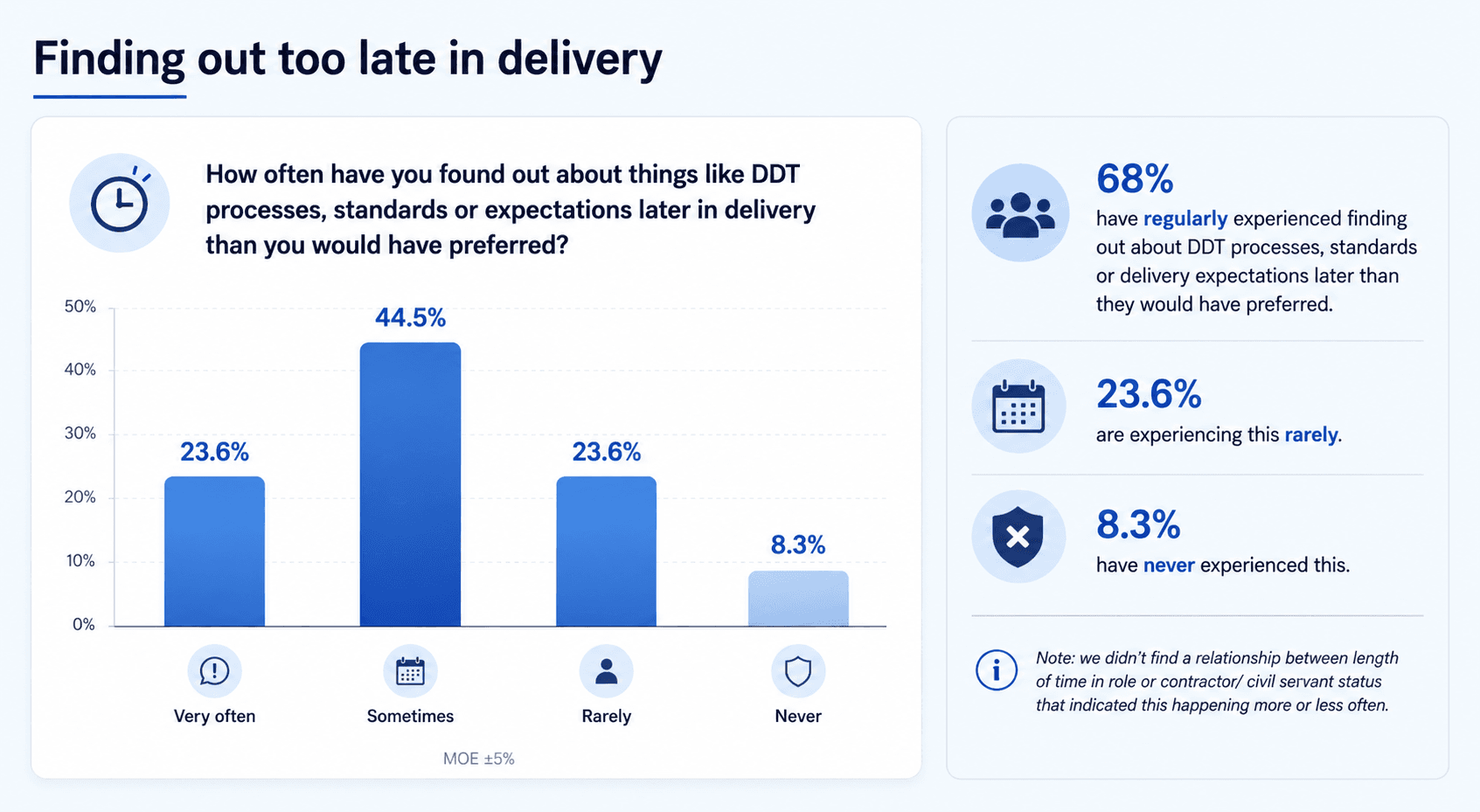
| Response | Percentage |
|---|---|
| Very often | 23.6% |
| Sometimes | 44.5% |
| Rarely | 23.6% |
| Never | 8.3% |
Other things people said in research
Make it shorter, simpler, more joined up and easy to implement. I also don't think it's just a guidance challenge. Are the requirements we put on teams too onerous? Could we be more proportionate or have a risk-based approach?
Better join-up between the different places that guidance sits - preventing me from jumping from place to place. Because of this, I default to asking a person first in case they can send me a direct link or answer which saves me time trying to find the right guidance and guess if it's up-to-date.
The problem we’re trying to solve
Right now, delivery teams cannot reliably:
- understand what guidance applies
- know when to apply it
- find what they need quickly
- trust that what they find is correct
This leads to:
- rework and delays
- inconsistent delivery
- increased risk at assessment
- duplication of effort across teams
What we’re aiming to do
We’re designing a new service that brings DfE digital delivery guidance together into one place. Our aim is to help teams:
- know what to do, when, and why
- find guidance quickly without needing to ask around
- apply standards earlier in delivery
- feel confident that they are doing the right thing
We're treating this as a service not just a single product or a collection of pages.
What we’re exploring
We’re starting to shape what a better experience of guidance could look like. A big part of this is creating a single, clear place for people to begin.
Currently users must navigate between different manuals and services, often without knowing which one they need. We want to shift that starting point so that people can begin with what they are trying to do, rather than where guidance happens to live.
Alongside this, we’re exploring how guidance can better reflect the reality of delivery. Teams do not work in manuals, they work through phases, decisions, and outcomes.
How to enable teams
We’re considering a ‘what to do when’ approach that helps people understand what’s expected at different stages, what good looks like, and what is proportionate for the work they are doing.
Standards are another area we’re focusing on. These are often discovered late or treated as something separate from delivery. We want to bring them into the flow of work so they are visible earlier, easier to understand, and something teams can act on as they go, rather than something they prepare for at the end.
Improving navigation and structure
We’re also looking at how to improve findability more broadly. This includes how content is structured, how navigation works, and how search can better support people who may not know exactly what they are looking for. The aim is to reduce the need to jump between different places or rely on others to point you in the right direction.
Finally, we’re thinking about how guidance is created and maintained. Currently, much of it relies on central ownership. We want to make it easier for subject matter experts and practitioners to contribute, so guidance can evolve through use and reflect real delivery experience.
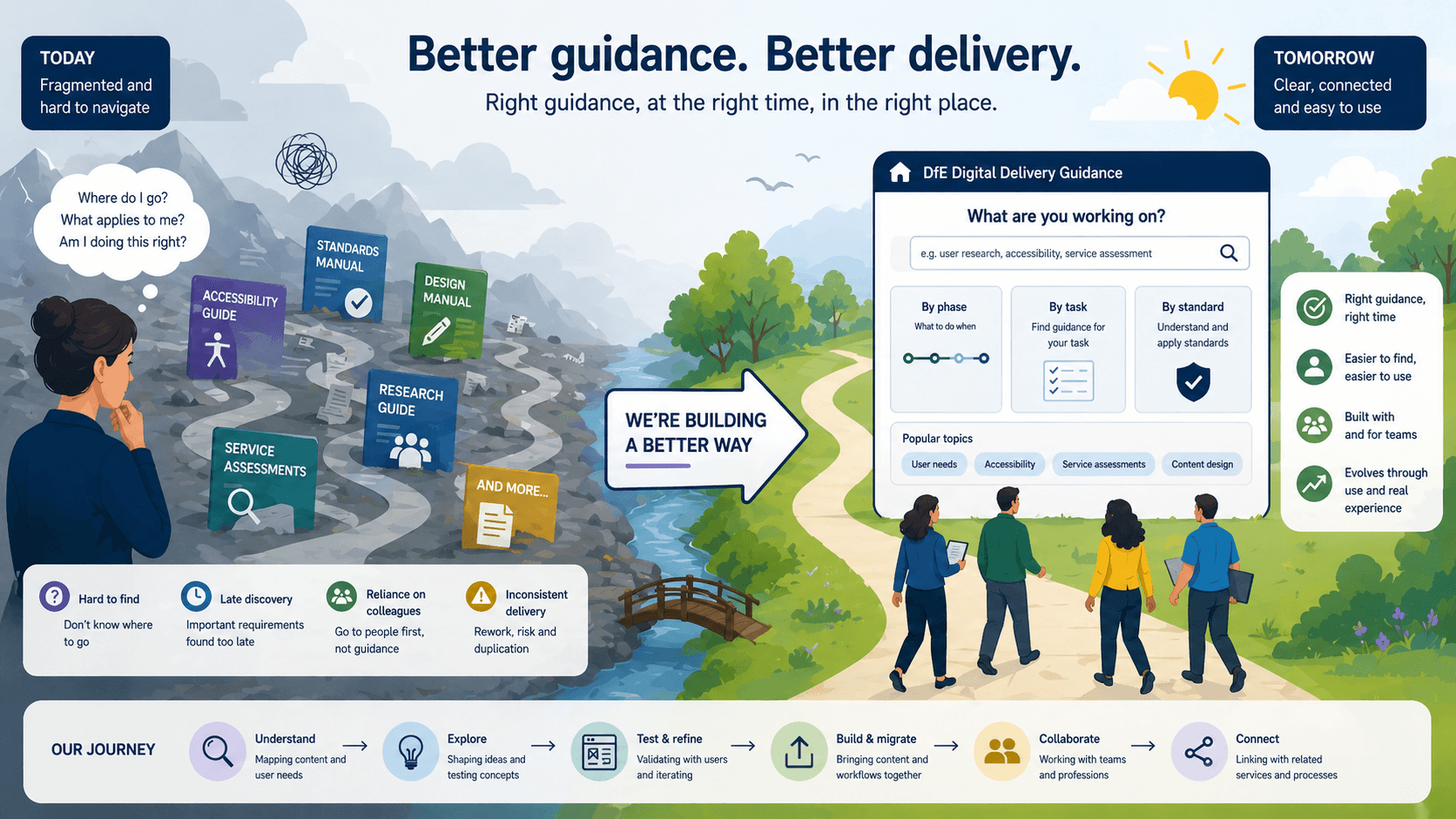
Caption
In the centre, an arrow represents a transition to a better approach.
On the right, the scene becomes clear and structured. A group of people walk along a single path towards a unified digital guidance service. The interface allows users to search by what they are working on and access guidance by phase, task, or standard. The environment is calm and organised, representing improved findability, earlier use of standards, and greater confidence in delivery.
What we’ve done so far
We started by understanding the current landscape of content.
This involved mapping all of the existing manuals and guidance, identifying where content overlaps, where there are gaps, and how things are structured today. Alongside this, we ran a DDT-wide survey and held workshops with stakeholders and subject matter experts to understand how guidance is used in practice. Through this work, we started to define key user needs and problem areas.
What we’re doing next
Our next focus is on testing and refining these ideas with users.
We’ll be exploring different ways of structuring and grouping content, including testing information architecture through user research. At the same time, we’ll begin migrating some existing content into the new approach, starting with standards, to help us test publishing workflows and content models in practice.
We’ll continue to work closely with professions and delivery teams to make sure what we’re building reflects how people actually work. We’re also starting to look more closely at how this service connects with others, such as service assessments, reporting, and governance processes.
What we’re learning
One of the most important things we’ve learned so far is that people do not think in terms of manuals.
They think about the task in front of them, the stage they’re at, and what they need to get done. If guidance does not match that way of thinking, it becomes something people work around rather than rely on.
This has been a useful shift for us. It means we’re not just reorganising content, we’re rethinking how guidance fits into delivery.
Get involved
We’ll continue to share progress as the work develops.
If you’d like to contribute, take part in research, or share feedback, we’d welcome your input. Contact the Design Ops team if you want to work with us on this project.