
Context
Applicants to teacher training courses need a GCSE in English and maths at grade 4 (previously C) or above. If candidates have GCSEs below this grade, we:
- ask them to confirm if they're planning to retake
- tell them they’ll need to prove their English and maths skills to a provider by other means if they’re not planning to retake
We could not do this for applicants with overseas qualifications, because we did not know if their qualifications were equivalent to GCSEs or if they were at grade 4 (previously C) or above. Applicants would enter details of their qualification and grade as free text and that would be passed on to providers.
This meant that we were unable to determine the eligibility of 34% of candidates, with many ineligible applications reaching providers. For providers, this led to:
- unreliable data (for example, when users entered the names of qualifications or grades in multiple different formats)
- inconsistent decision making on applications
- longer processing times due to having to review ineligible applications
Lacking structured data also made it harder to analyse our own data and make informed decisions about our service based on it.
We decided to resolve this by introducing international qualifications as structured data. By doing this, we expected to be able to assess candidate eligibility in the service with a higher level of confidence.
Analysing the data
We reviewed candidate submitted qualifications to identify which countries contribute the highest number of applications. We identified Nigeria, Ghana and Kenya, which together account for 20.8% of our applicants.
We then worked out whether the qualifications were at GCSE level and which grades were equivalent to grade 4 (previously C) and above.
When we had confirmed the relevant qualifications and grades, we:
- identified common and alternative names for the qualifications
- looked into which offer a grade for specific subjects, rather than an overall diploma-type qualification
- looked at which qualifications do not cover English and maths
- looked into historical grading systems
- identified other countries using the same qualifications
- received confirmation of equivalence from the DfE Professional Recognition team
Designing the new flows
We agreed an MVP that included Nigeria, Ghana and Kenya as the countries with the highest volumes of applications. The West African Senior School Certificate Examination (WASSCE) that is used in Nigeria and Ghana also covers Sierra Leone, The Gambia and Liberia, so we also included those countries.
We then designed a solution that:
- captures qualifications and grades from those countries in a structured way
- assesses grade equivalency
- warns users if their grade may not be sufficient and prompts them to provide alternative evidence for providers to assess
The previous user journey
After users have selected that they have a qualification from outside the UK, users from Nigeria, Ghana, Sierra Leone, The Gambia, Liberia and Kenya previously followed this sequence.
- Users entered the name of their qualification in a free text box.
- Users selected their country.
- Users were asked to provide a statement of comparability from the UK National Information Centre (UK ENIC) or declare that they do not need one.
- Users entered their grade in a free text box.
The new user journey
Applicants are now asked to select the country where their qualification was awarded before entering details about the qualification and grade.
Applicants who select Nigeria, Ghana, Sierra Leone, The Gambia, Liberia or Kenya are then prompted to select the GCSE-equivalent qualification for their country.
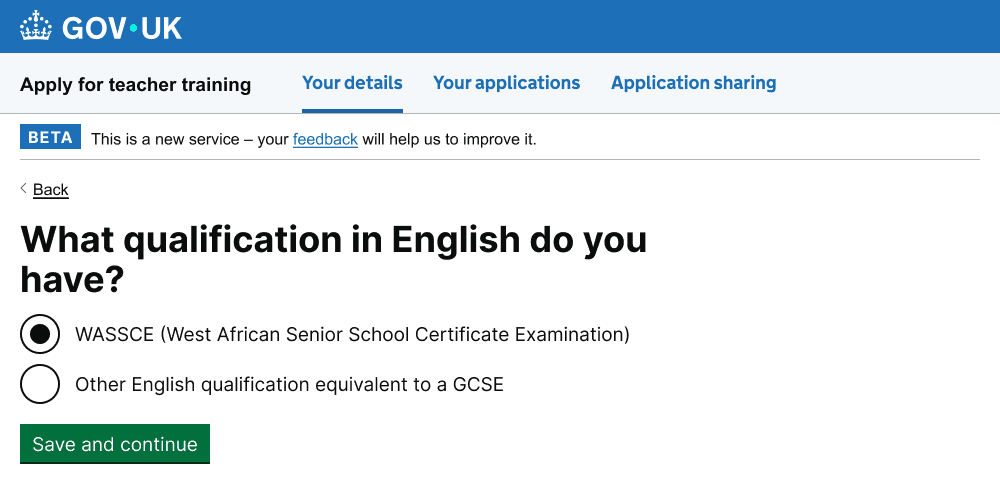
They can then select their grade.
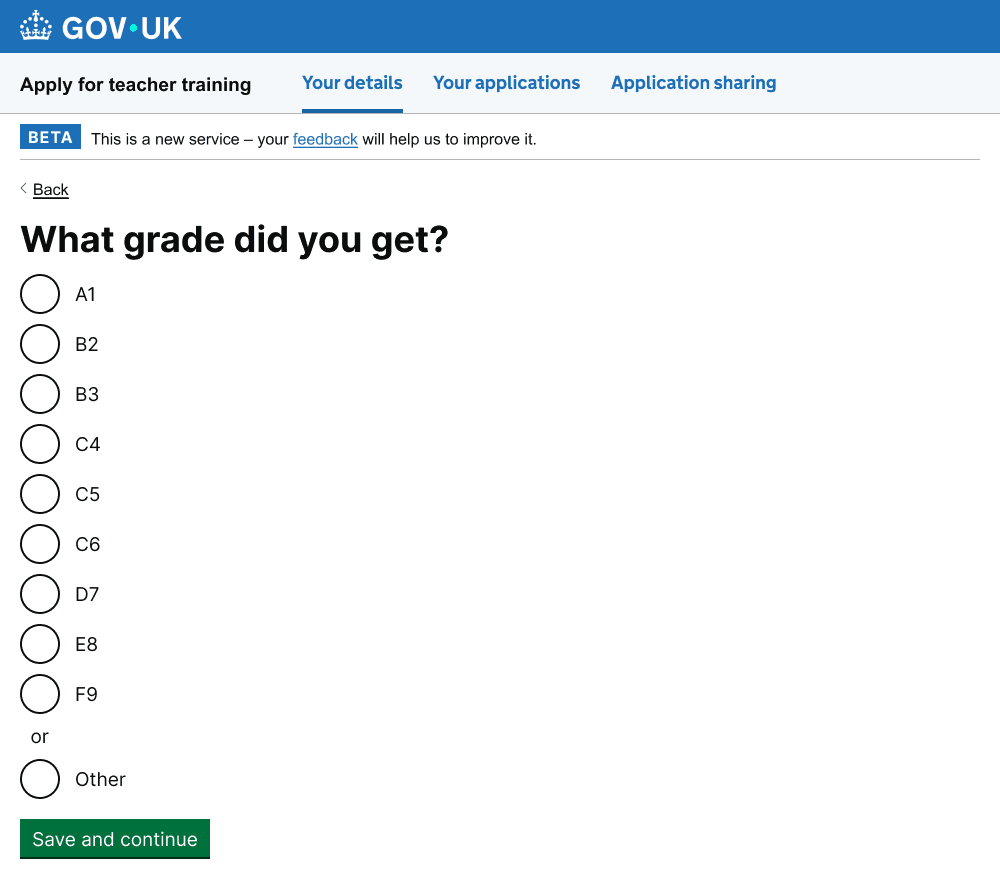
If they believe they have another qualification that’s equivalent to a GCSE, they can select this option and still enter their qualification and grade as free text.
If the user selects a grade that’s not equivalent to grade 4 (previously C) or above, they are routed to a warning screen.
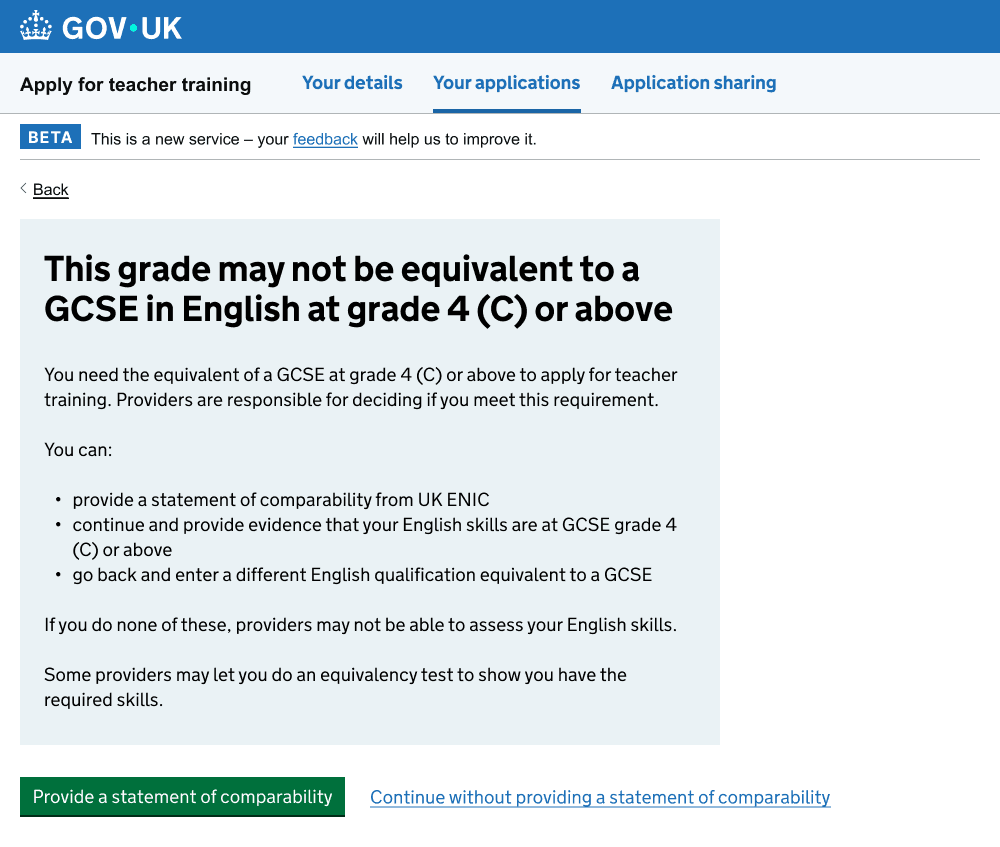
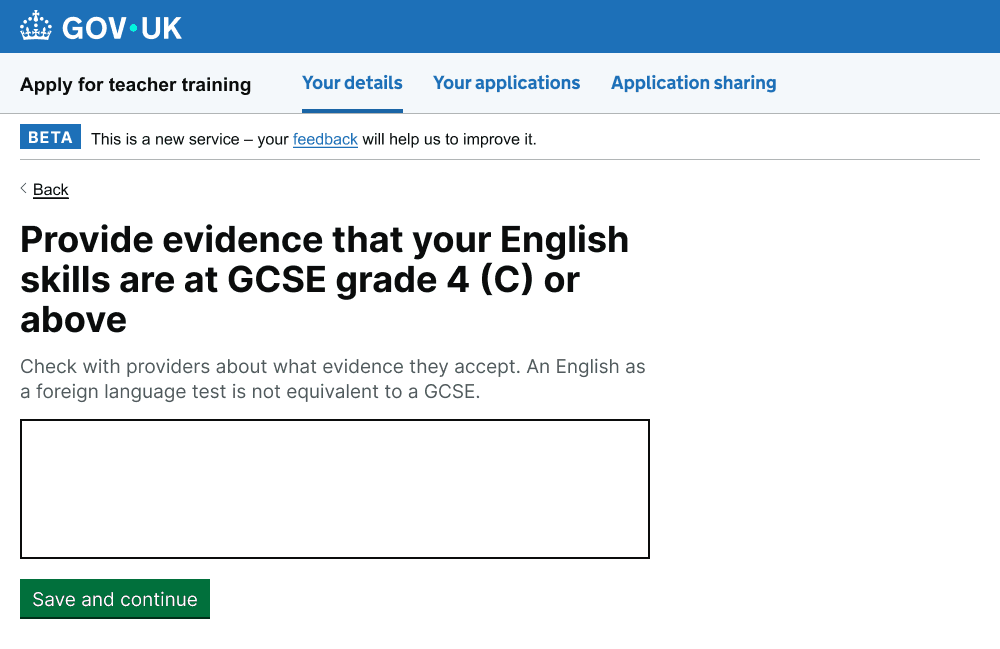
They can provide a statement of comparability from UK ENIC or provide further evidence of their skills.
What’s next?
We plan to carry on user research on this feature with applicants and providers. A particular focus of provider testing will be around understanding the acceptable forms of evidence an applicant can provide to providers. This will enable us to provide better guidance to applicants on that screen.
We expect an increase in structured qualification data resulting in higher confidence when determining candidate eligibility. We will assess the performance of this new flow via metrics.
We also plan to investigate the possibility of expanding this feature beyond MVP to include other countries, including ones with more complex qualification structures, and potentially introduce historical grading.