
Why CXD built a joined-up online safety service for parents
In late 2024, the Minister for Early Education asked the department to explore how government could better support parents to keep their children safe online.
As a cross-cutting team focused on solving the most pressing problems faced by DfE users, this challenge was a natural fit for the Customer Experience and Design (CXD) team.
Understanding the problem space
To ensure we had a good grasp of the problem, we began with desk research, followed by a one-day workshop in February 2025.
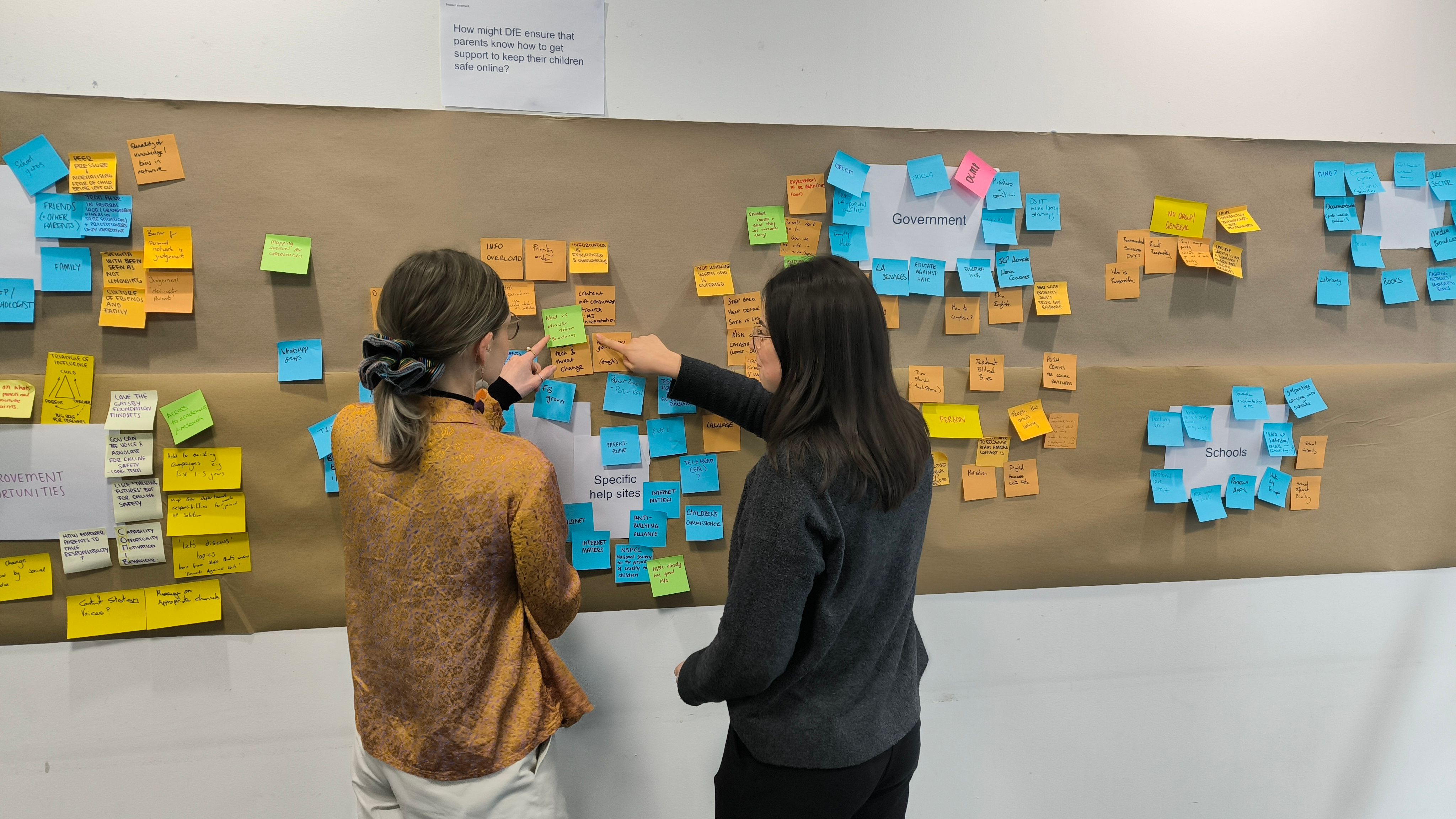
The workshop brought together DfE policy colleagues from safeguarding, curriculum, technology, CONTEST, and VAWG teams. Together we explored how parents access support, as well as opportunities for improvement.
Photo of participants during the first DfE policy workshop in February 2025:
Mapping the landscape
Early mapping showed that there isn’t one single place to find online safety information. Instead, the landscape is made up of information from:
- government departments – set legislation and policy (e.g. DSIT Online Safety Act, DfE Teaching online safety in schools policy)
- regulators – enforce legislation (e.g. Ofcom enforces the Online Safety Act)
- internet and service providers – offer paid products and free advice
- charities – provide specialist and general support online, in person, and by phone
- schools and local services – often the first point of contact for parents
A map of the interventions that exist to keep children safe online, highlighting the fragmentation of ownership and advice:
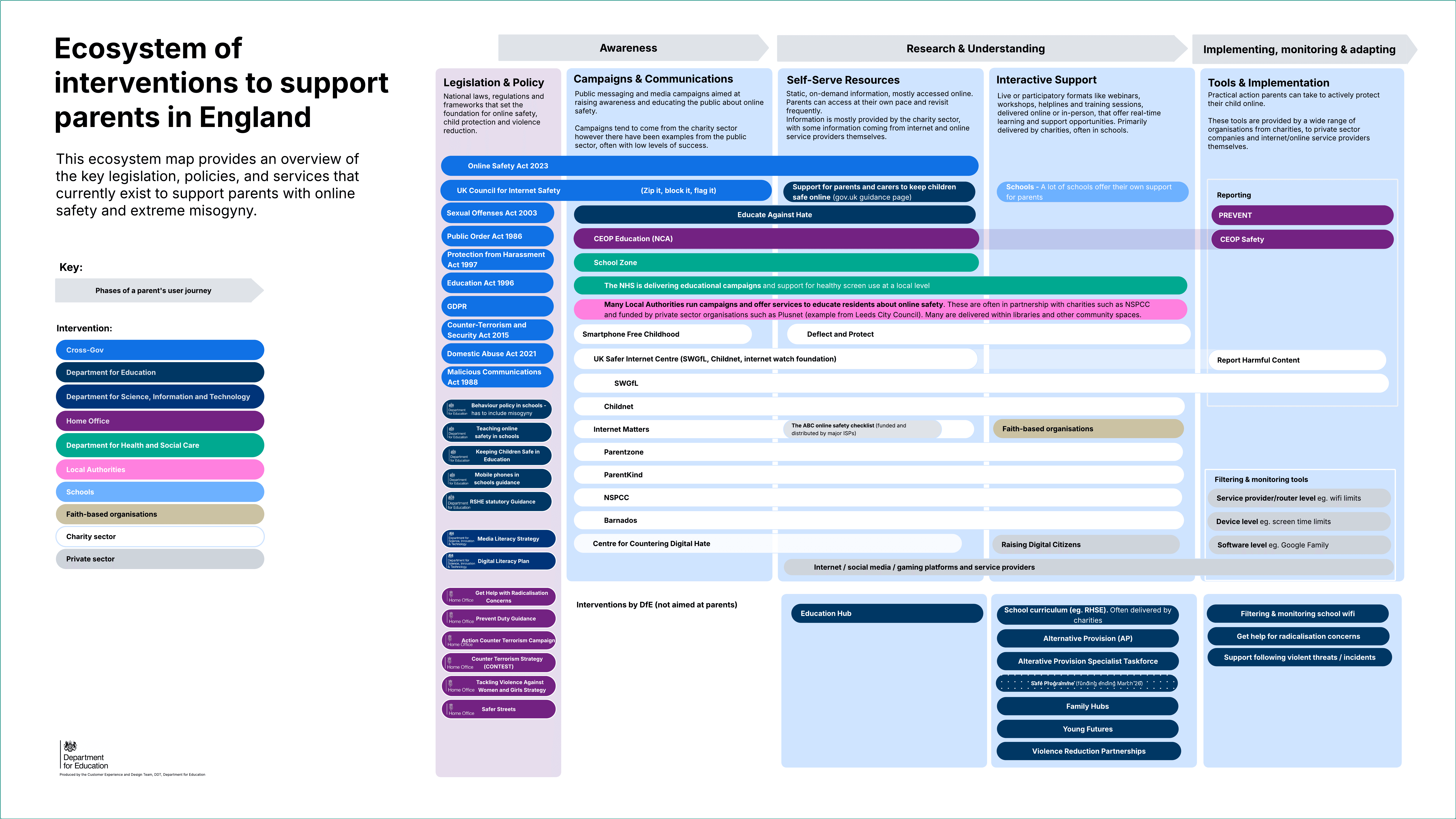 User research showed that this fragmentation leaves parents feeling overwhelmed and unsure of what to trust or do.
Parents told us:
"I only want to go to one source I don’t want to go to five" - UR1
"I feel like there should be a go to, but I don’t know where that is. I feel quite overwhelmed" - UR1
"I would definitely look at gov resources for help… I would expect a dummies guide/something easier to understand" - UR1
Identifying parent needs
We carried out multiple rounds of user research to understand parents’ needs.
This research showed that parents need:
- clear, bitesize, and actionable information that is easy to read, helping them understand what to do and take the right steps without feeling overwhelmed
- supportive guidance that recognises the challenges of parenting online, so parents don't feel judged
- clear actions they can take, giving them confidence to support their child’s digital wellbeing
- access to trusted organisations and helplines, so they know where to turn for help
- guidance at key digital milestones, enabling parents to make informed decisions and set appropriate boundaries
- practical support to have conversations with their child about online safety
This formed our core user needs, which our MVP would meet.
Designing to meet out user’s needs
Between August 2025 to February 2026 the team worked at pace to design and launch the service, with a clear focus on meeting the needs of parents.
We began by mapping the landscape and identifying stakeholders. We identified and worked with over 30 stakeholders from other government departments, arm’s-length bodies and specialist charities.
This helped us to understand where parents experienced challenges, enabling us to identify where and how our service could add value.
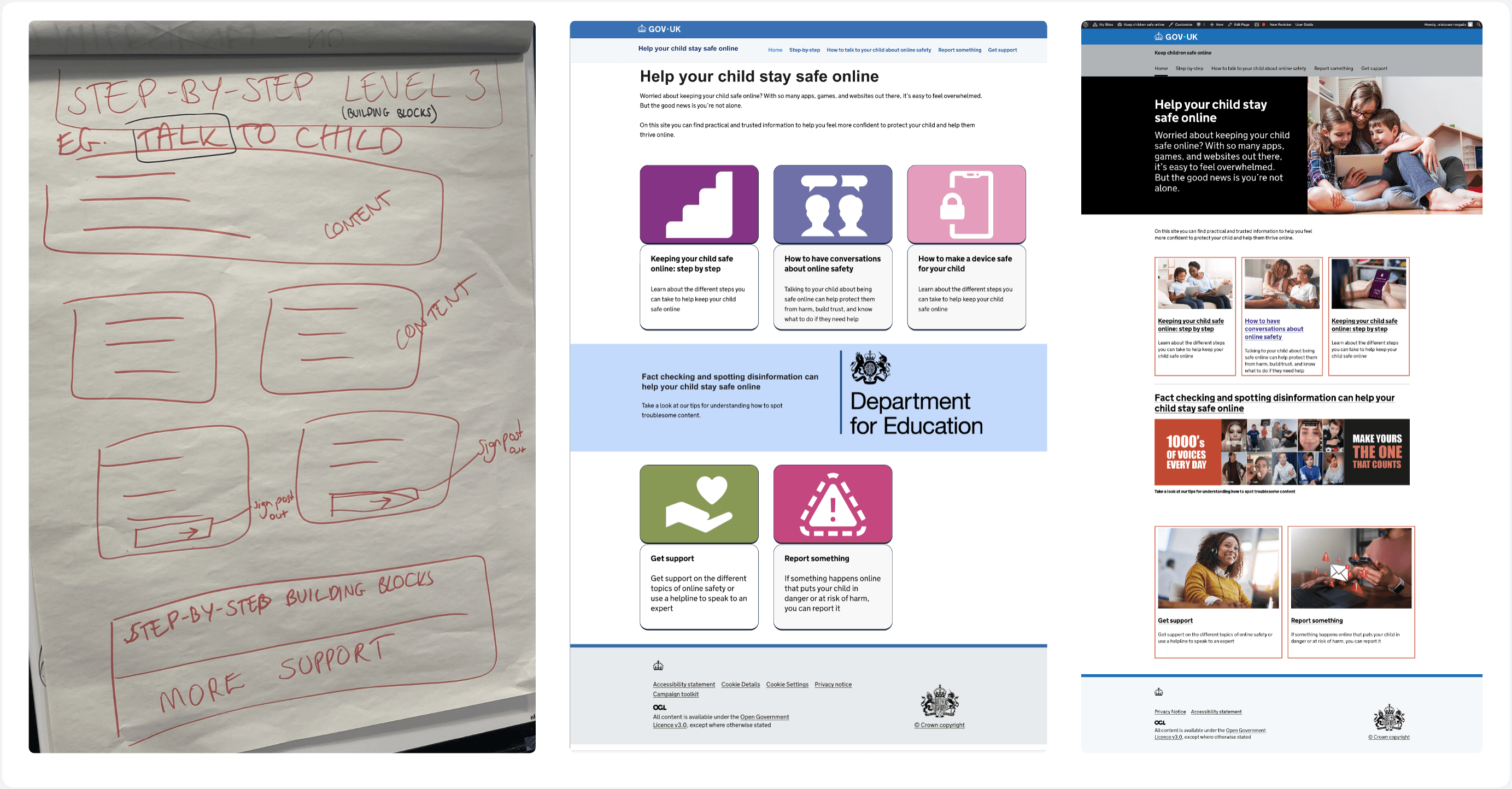
Throughout, our design approach was iterative and user centred. We continuously sketched, prototyped and refined as our knowledge grew. We spoke directly to parents to test our designs and help us improve.
Iterations of the site included: lo-fi sketches, mid-fi Figma prototype, early iteration on WordPress.
Working in partnership with DSIT
An early and key stakeholder identified was the Department for Science, Innovation and Technology (DSIT), which leads on the Online Safety Act and the government’s media literacy strategy.
Engagement with DSIT helped us to understand their upcoming campaign to educate parents of the dangers of toxic content online.
The campaign directly aligned with our aims and users, so we agreed to launch the Kids Online Safety service jointly with their campaign.
We worked closely with DSIT throughout, involving colleagues in daily stand-ups, user research interviews well as ideation and sprint planning sessions.
DSIT shared research insights and draft campaign materials, which we reviewed through a user-centred lens.
This approach ensured collaboration and alignment throughout and has created a smooth journey from the campaign to our service.
Delivering our service
On 10th February 2026 we jointly launched our Kids Online Safety service with the DSIT toxic content campaign.
Our service brings together trusted online safety advice for parents, providing:
- age specific guidance
- practical steps to follow
- conversation prompts
- trusted support routes and signposts
- a landing site for parents to learn more after seeing DSIT’s campaign
- space for future expansion as policy, risks and parental needs evolve
Ongoing user research has indicated that the service is easy to navigate, builds confidence, and supports parents to understand the actions they need to take.
During user research following the launch of the site, parents told us:
"It provides me with all the information I need in order to keep my child safe online" - UR4
"It covers all the basics like talking to my kids, setting controls, getting support and reporting issues, exactly what I’d want for keeping them safe online" - UR4
"It gives clear, simple explanations and breaks topics into manageable sections" - UR5
What’s next?
The team are continuing to grow the site to meet additional user needs.
This includes a dedicated section on violence against women and girls, with supporting pages to help parents have informed, honest and supportive conversations with their children.