
What is the EYFS profile assessment?
The EYFS profile is completed at the end of the reception year. It assesses children against 17 Early Learning Goals (ELGs).
Its main purpose is to help children make a smooth transition into year 1. The EYFS profile supports professional conversations between Reception practitioners and year 1 teachers, giving teachers a clear picture of each child’s development and learning needs so they can plan the year 1 curriculum effectively.
The EYFS profile is a summative assessment, based on what practitioners have observed throughout the reception year. For each ELG, children are assessed as either ‘emerging’ or ‘expected’.
This data is submitted to the local authority and then passed on to DfE.
Ofsted will have access to school level EYFS profile data for data submitted from the summer term 2026 onwards. It will be used as a starting point for conversations during inspection – Ofsted will not make gradings solely using EYFS profile data.
Why this support was needed
The government has set a target for 75% of children aged 5 to achieve a good level of development by 2028.
The DfE policy team found anecdotal evidence through stakeholder engagement that EYFS profile assessments are not always applied consistently or aligned closely enough to the early learning goals.
To address this, we worked alongside the policy team to develop support for teachers completing the EYFS profile with the aim of improving the consistency and reliability of assessments. We published the support – including bite sized videos, written content and case studies - on the Help for Early Years Providers website in March 2026. This support sits alongside funding local authorities to facilitate EYFS profile assessment support for school sand pre-reception settings, which aim to support practitioners to support best practice.
User research
We conducted 5 rounds of user research with early years practitioners between August 2025 and January 2026. Our aims were:
- to provide evidence and feedback to policy colleagues to inform the content of the support materials
- to make sure that users could easily access, navigate through and use the resources
Round 1
In round 1, we conducted interviews with early years practitioners to identify their main pain points with the EYFS profile assessment. Our key findings were:
- the EYFS profile is a benchmark to show a child's progress but is missing some nuance
- they collect evidence throughout but properly look at ELGs in the summer term
- reception teachers are 'trusted' to design their own curriculum
- less tangible/demonstrable ELGs are more difficult to make judgements on
- being able to discuss and have a dialogue with colleagues around the EYFS profile is crucial
- resources to support the EYFS profile tend to be used to prep or to reflect
- information around the EYFS profile needs to be broken down and visual
- exemplification is the most desired improvement for helping them make secure judgements
These findings confirmed our assumptions that the most essential content for supporting the EYFS profile would be exemplifications and case studies, alongside quickly and easily digestible visual information for teachers who are time-poor.
Round 2
We tested a proposed structure for the pages and asked teachers what content they thought would be essential in each section. Our initial design broke the support into three sections which would be accessed from a single home page on the HfEYP site.
The proposed page navigation mocked up using Excalidraw
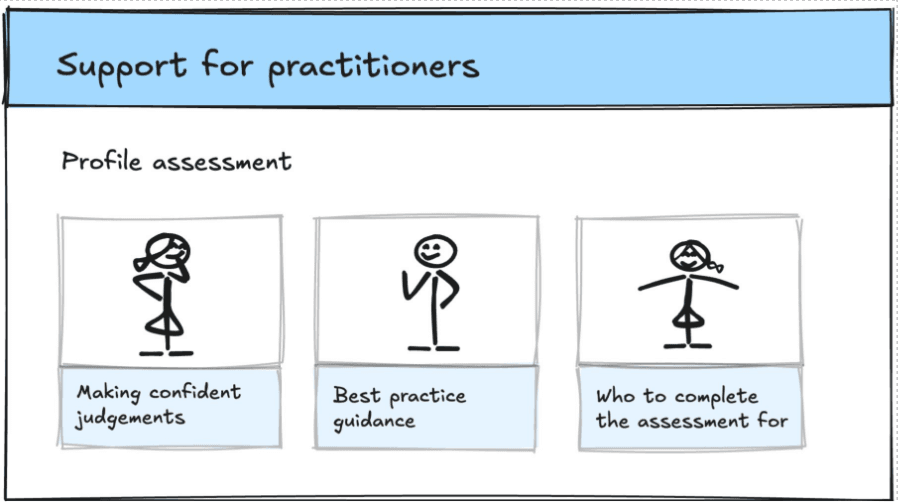
We found that most participants found this structure intuitive and easy to navigate. However, some users were unclear on what content would sit within the ‘Who to complete the assessment for’ section as they assumed that the assessment needed to be completed for all children.
We again found that teachers considered exemplification materials and case studies to be must-haves. We also found that teachers wanted specific SEND guidance in all sections, which emphasised the need for specific and targeted SEND support.
Round 3
In round 3, we tested a draft of a guidance page aimed at improving confidence in assessing the Writing ELG. Participants were asked to read the page and score their confidence before and after reading it.
We found that users were happy with the structure of the guidance pages and liked the layout of assessment criteria, key advice and case studies. Most participants raised that they wanted to see more case studies, which again validated that examples from real practice were the most essential need for teachers.
Round 4
After testing the proposed navigation in round 2, we decided that it would take too long to implement the necessary architecture on the HfEYP site before the publication deadline and instead decided to place the EYFSP guidance within the existing ‘support for practitioners’ section on the site. In round 4 we tested this approach with a new side navigation.
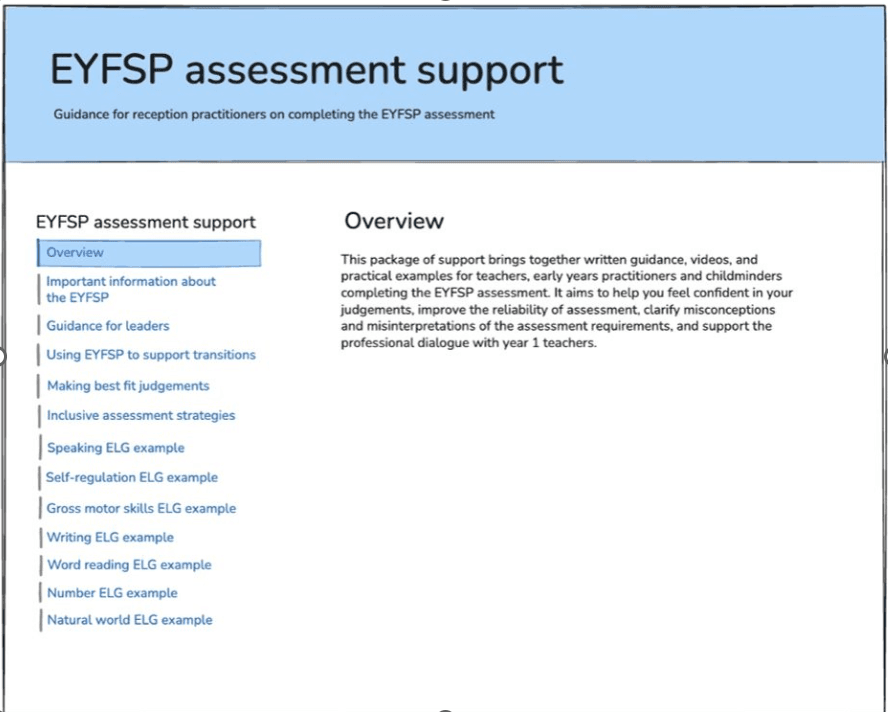
We found that users could use the side navigation without difficulty and all participants expected to find this content under the ‘support for practitioners’ section, which validated our approach.
We also tested draft content for the Word Reading and Writing ELG pages and the guidance for leadership page. Feedback from participants allowed us to iterate this content to make it easier to digest, including using bullets to break up long paragraphs of text and including more examples of ‘Emerging’ judgements.
Round 5
Our final research round tested the inclusive strategies page, including the video. Participants were asked to navigate to the page and review the content. We found that:
- overall, participants thought the information on this page was very clear, useful and straightforward
- 9 out of 10 would refer to it or refer someone else to it in the future
- users suggested improvements to formatting to make the content more scannable and easier to read
- generally, participants didn't feel anything was missing
- participants responded well to the video and would choose to watch it over reading long chunks of text
We used this feedback to make some general improvements to the page, including breaking up paragraphs and making use of bullets.
What’s next
Now that the support package is live, we’ll monitor user feedback to look out for any future improvements to the content. We’re also implementing Microsoft Clarity on the HfEYP site, which will help us to understand how users interact with the content and could inform improvements to the pages in future.