
Context
To check whether a qualification is considered full and relevant, users must answer several questions, including when the qualification was started and when it was awarded.
The start date is essential for determining which criteria apply when assessing a qualification. The award date is necessary to tell users when the qualification holder may need to meet other additional requirements to be counted in specific staff:child ratios.
When doing the check, users usually have the qualification certificate at hand to help them answer all the questions they are asked. However, unlike the award date, the start date does not appear on the qualification certificate, making it difficult for users to provide that information.
For managers, this situation adds unnecessary time and frustration to an already busy workload, making them leave their work to find this information, only to return later to continue the verification. For practitioners, this means they usually need to guess when their qualification was started which may lead to inaccurate results.
Existing start date and award date designs
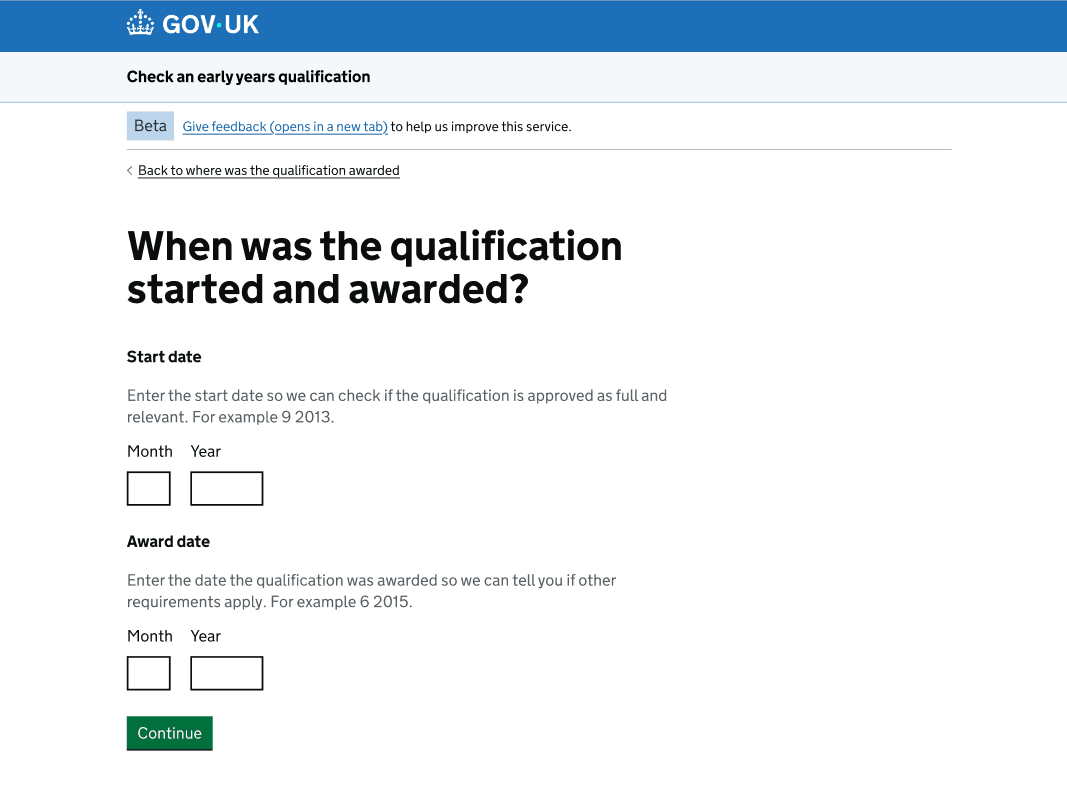
We currently ask users to provide both the start date and award date on the same page.
We chose to deviate from GDS standards in this case, which recommend having one question per page, and instead grouped related questions together.
Our decision was based on research that showed that users often entered the award date when asked for the start date because they only had the award date available. This behaviour was consistent with users’ experience of the EYQL spreadsheet and led some to mistakenly believe that the start date was a new requirement introduced by the online service, when it was not.
You can read Improving how we ask for the start date for further detail on this decision.
Research findings
In January 2026, we conducted usability testing with practitioners to understand how they navigate through the online service and identify what could be improved.
Providing the start date was particularly challenging for most practitioners, who had to guess it, especially for qualifications that started a long time ago.
Some practitioners said that they do not usually keep all the paperwork, including the date they started their qualification.
What we did
We reviewed whether there were any scenarios in which we could eliminate the need for users to provide the start date of their qualification.
We identified that the specific month and year a qualification started is not always essential if we can confirm that it started before 1 September 2014. This is because some qualifications are considered full and relevant only up to that date, regardless of when they were actually started.
Explored potential further improvements
Because we could clearly distinguish between qualifications started before 1 September 2014 and those started on or after that date, we explored whether additional date range options could further reduce the need for users to provide a specific start date.
We went through the early years qualification list and mapped all the different qualification dates to understand from which date and until which date each qualification was considered full and relevant.
We found that there are 30 different date ranges, some of which overlap and would still require users to enter a specific month and year.
Adding more date range options would also increase cognitive load and completion time, be difficult to maintain, not scale well as new qualifications are added to the list, and affect guidance across the service, as these pages depend on the start date.
What we changed
To make it easier for users who are checking old qualifications, we split the ‘When was the qualification started and awarded?’ page into 2 pages:
- When was the qualification started?
- When was the qualification awarded?
New start date page
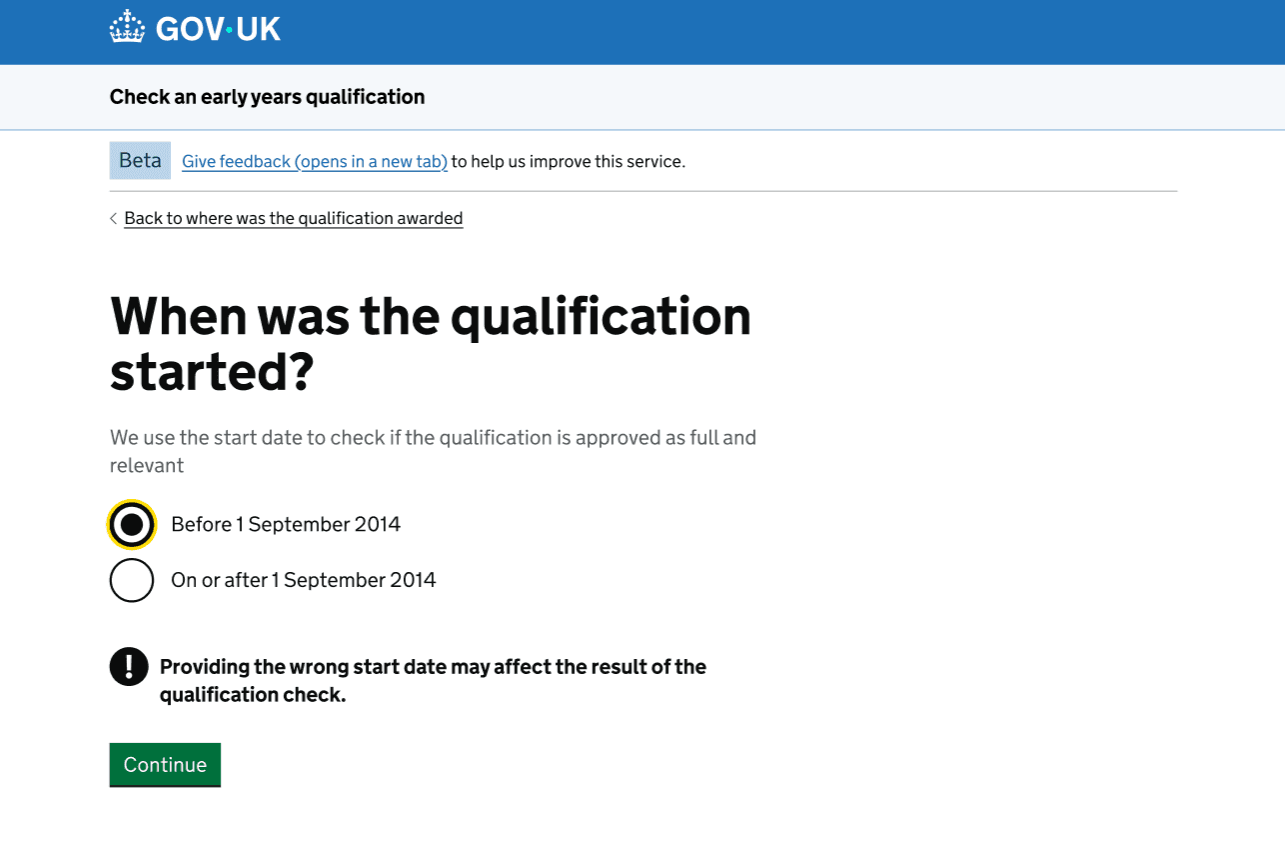
We replaced the month and year text fields with 2 radio options:
- Before 1 September 2014
- On or after 1 September 2014
If users select ‘Before 1 September 2014’, we can determine whether the qualification is on the list without asking for a specific month and year.
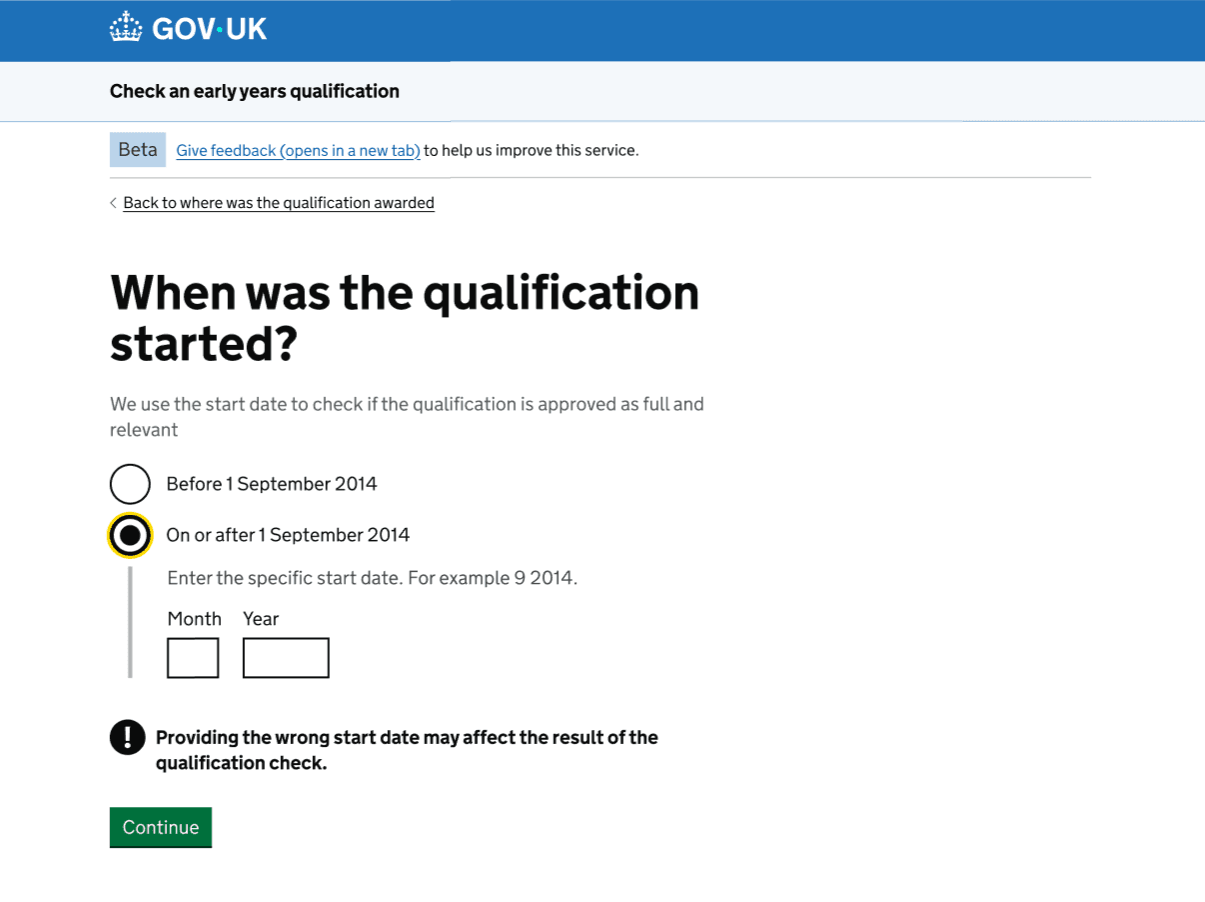
If they select ‘On or after 1 September 2014’, a related question gets revealed asking to provide the specific month and year. This is necessary because there are many possible date ranges for approved qualifications, and without this information we would not be able to provide an accurate result.
This change makes the check process easier for users who do not remember their qualification start date because it was a long time ago.
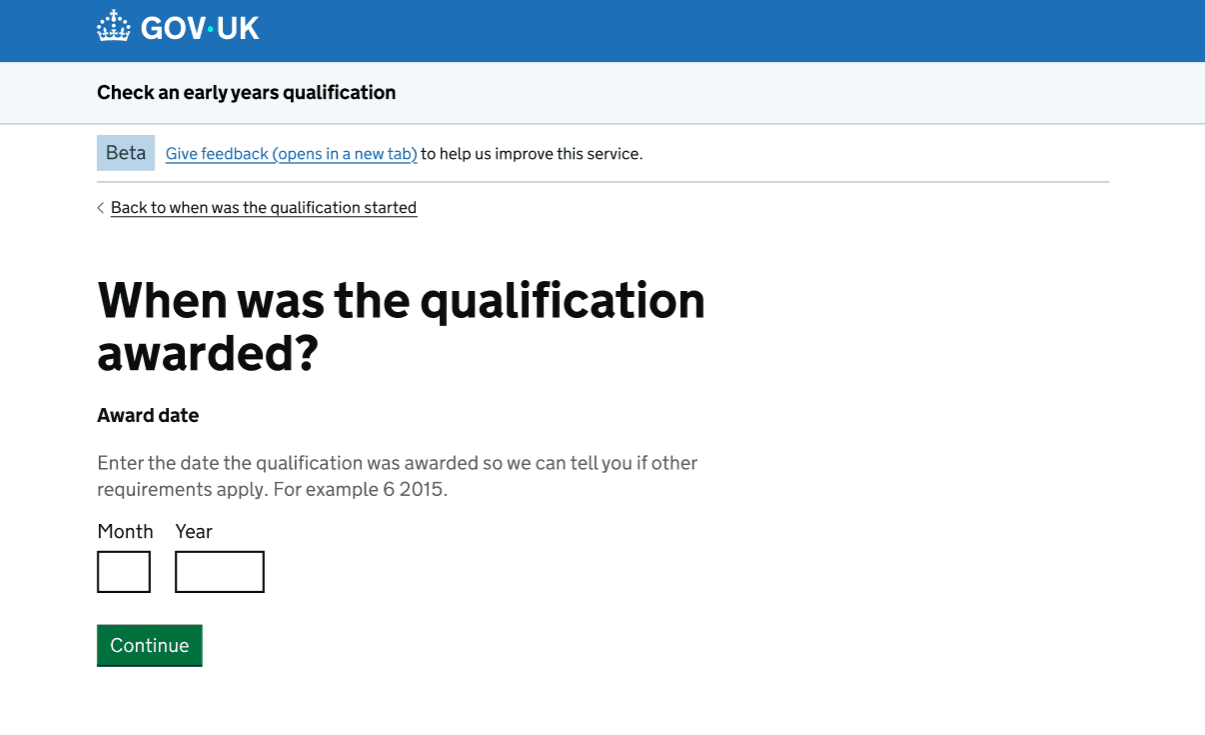
New award date page
As we split the start date and award date page into 2 separate pages, we updated the backlink text and updated the page heading on the new award date page.
Updated other pages
Splitting the start date and award date question page into 2 separate pages required splitting the ‘When was the qualification started and awarded?’ row in the table on the ‘Check your answers’ page into 2 separate rows:
- When was the qualification started?
- When was the qualification awarded?
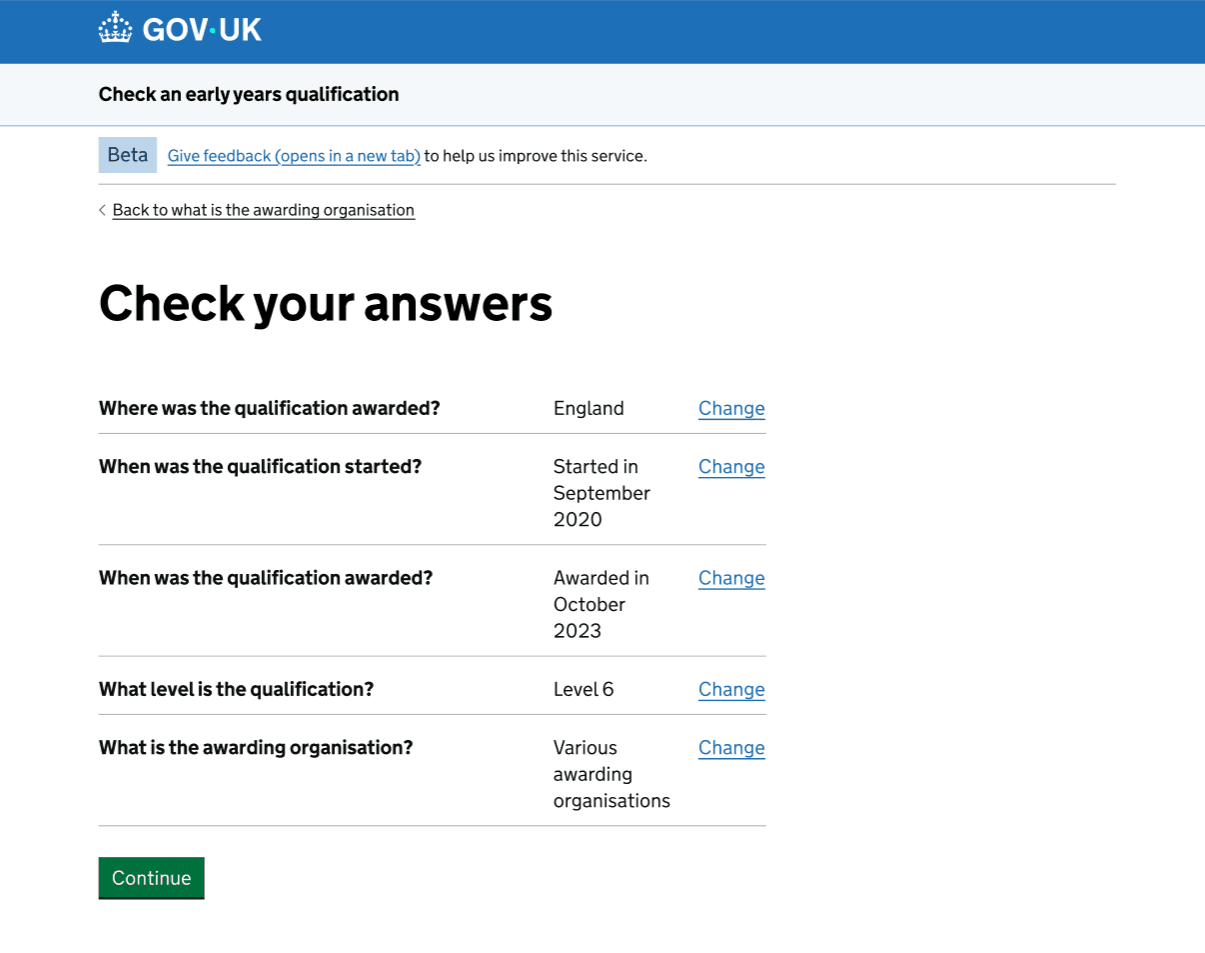
On the start date row, users will see the specific month and year they provided, unless they selected ‘Before 1 September 2014’. In that case, that option will be shown instead. This information will appear on all pages where the start date is shown.
Next steps
We will monitor service performance and user behaviour by:
- monitoring drop-off rates
- monitoring whether users change their answer from ‘On or after 1 September 2014’ to ‘Before 1 September 2014’, which may indicate avoidance of providing a specific month and year
- monitoring any user queries related to the qualification start date to identify emerging issues
- including the new start date page in any future usability testing