
We are currently developing the information architecture for the DDT delivery guidance (product name to be agreed in a naming workshop). The guidance covers a wide range of topic areas so it’s important that content is organised in a way that matches how users expect to find it.
Currently, the guidance is published across 16 manuals, and this product will bring it all together.
We ran a card sort to inform an initial structure.
The problem
We did not have evidence for how content should be grouped.
There was a risk that:
- categories would reflect internal thinking rather than user expectations
- users would struggle to find information
- navigation would become difficult to use
We needed to understand users’ mental models before defining a structure.
What we did
We conducted an open card sort with 9 participants.
Participants were:
- given a set of content topics from the guidance in a randomised order
- asked to group them in a way that made sense to them
- asked to name each group
We reviewed how participants:
- grouped content
- labelled categories
- handled unclear or cross-cutting topics
What we learned
We found consistent patterns across participants:
- users often grouped content by task, goal or topic
- some groupings appeared repeatedly, suggesting strong shared expectations
- naming varied, but intent was often similar
- some items were grouped differently by different users, indicating ambiguity
This helped us identify:
- stable groupings we can rely on
- areas where labels may need to be clearer
- content that may need to appear in more than one place or be cross-linked
Examples include:
- accessibility guidance was strongly grouped together, but profession guidance was also recognised as being relevant to 2 topic areas (accessibility and profession)
- common groupings of 'accessibility' 'standards and assurance' and ‘profession guidance’ - but with an awareness that profession guidance should be linked, across accessibility and relevant profession areas, as we don't work in siloes
- users interchangeably grouped standards and assurance, which helped us pull 2 topic areas together
- a strong search functionality is important
Outcome
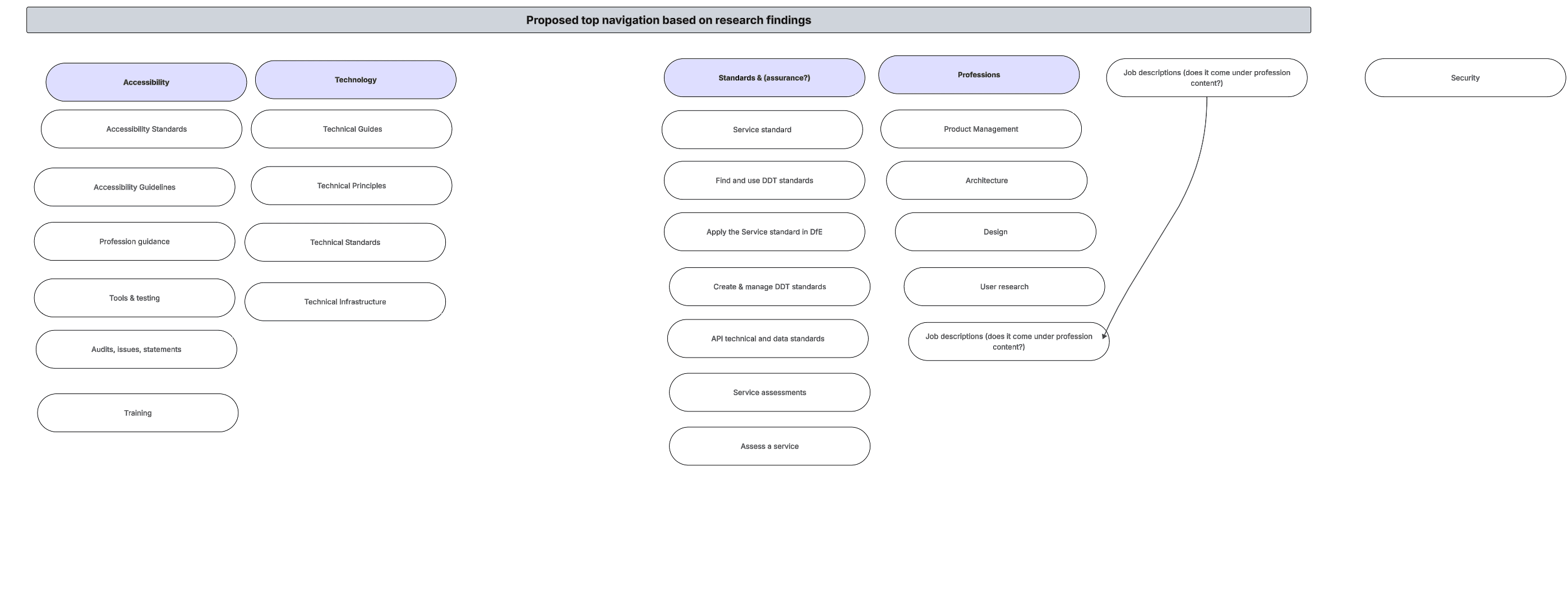
We used the results of the card sort to create a draft structure for the manual.
The structure:
- reflects common groupings identified by users
- uses related links where users expect to see references to similar content topics
- supports task-based navigation
- highlights content that may need additional support, clearer labelling or content that does not yet exist but there is a desire for
'I’ve struggled to find really clear guidance, what to do in each phase,' participant 2
‘So hard to understand as a service designer within DfE, what needs to be done,’ participant 5
‘I stumble across things, rather than it being bookmarked,’ participant 8
Screengrabs of proposed high-level information architecture
Lucid board highlevel sketch:
Adding information architecture to the product:

Next steps
We will:
- test the draft structure using a tree testing exercise
- refine group names and groupings based on findings
- continue iterating the information architecture as content develops