
School Account – concept testing round 2
For round 2 of our alpha user research (and the final round before the upcoming alpha assessment) we built on the concepts from round 1 and took these back to users to understand how useful they might be.
We wanted to look at the idea of School Account as a ‘joined-up’ service and understand user expectations when it’s necessary to ‘leave’ School Account to complete a task, then return to it.
As with round 1, we were also focussing on testing our riskiest assumptions – the goal was to explore the value of different aspects of the concepts, understand where we can reduce burden and improve efficiency, and crucially, help build confidence for school and trust leaders.
Risky assumption 1: Consolidation reduces effort and it is universal
In both rounds, we’ve heard that users struggle to find DfE guidance and information. We’ve consistently heard the current experience described as ‘fragmented’, with users expressing frustration about an experience that feels ‘scattered’ across different portals with multiple logins.
In this round, some of the most significant iterations were made to the hub page, where we wanted to test a combined view, bringing compliance reminders, opportunities and guidance into the same view, along with the most urgent/upcoming/priority actions at the top.
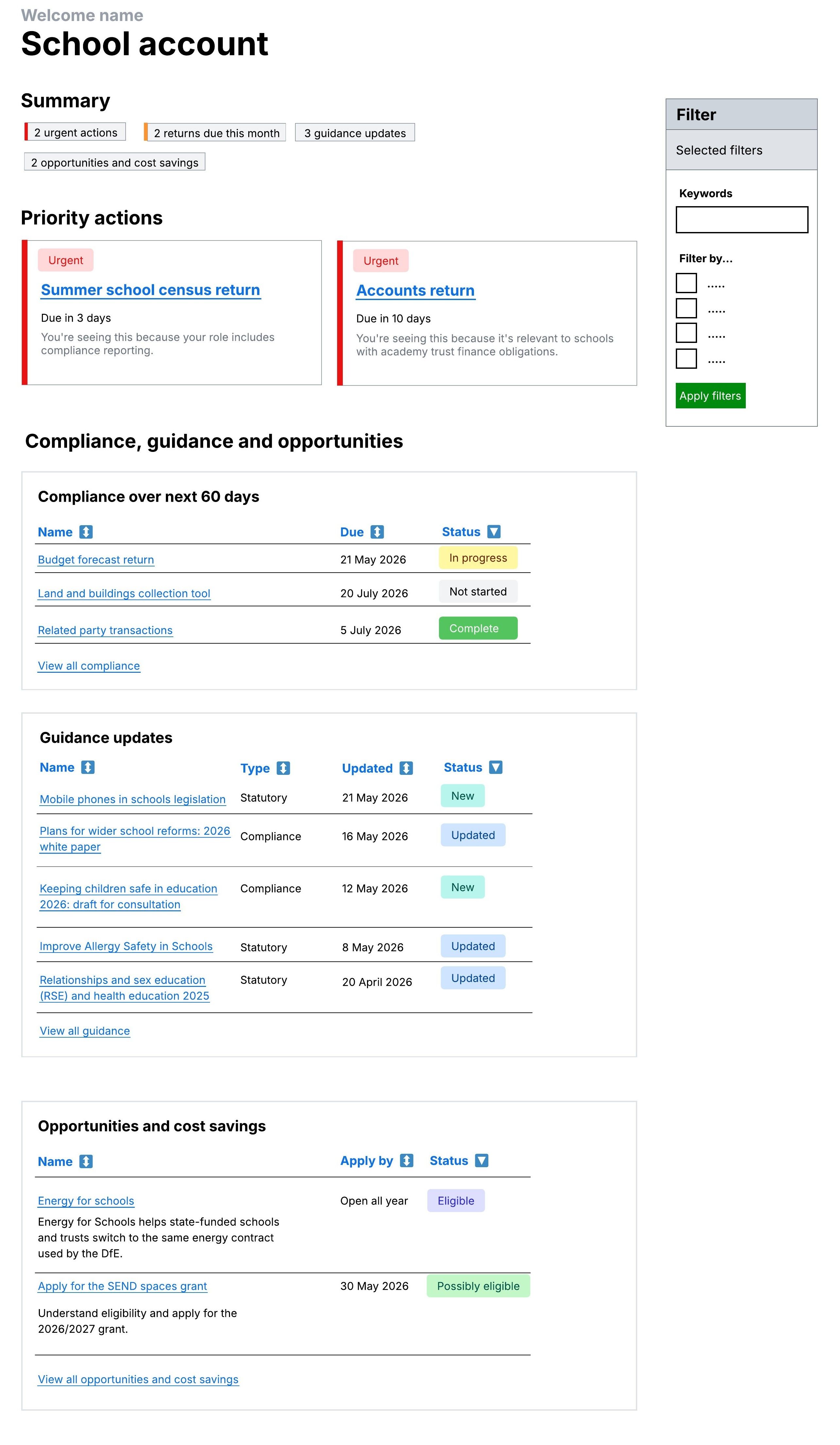
Feedback on the updated screen was positive, with users highlighting that the hub page reduces effort, improves clarity and helps them to quickly understand what’s due and what’s completed. It supports prioritisation and offers visibility of progress, particularly for those overseeing work at a higher level.
Overall, users began to see the hub as a ‘control centre’ that simplifies navigation, improves decision-making, and increases confidence in accessing accurate, up-to-date information. The research suggests that consolidation does solve a problem and offers real value for users.
Risky assumption 2: It will feel joined up to users
Again, across both rounds of research, participants talked about a disjointed and inefficient experience when working through current DfE service journeys.
The nature of School Account as an ‘experience layer’, and the way it will need to interact with other services is important to understand, because at some point users will need to be shepherded to other services to complete actions, before being brought back into School Account.
We wanted to explore where users would expect to go as part of looking at the overall end-to-end journey.
Sign-in page
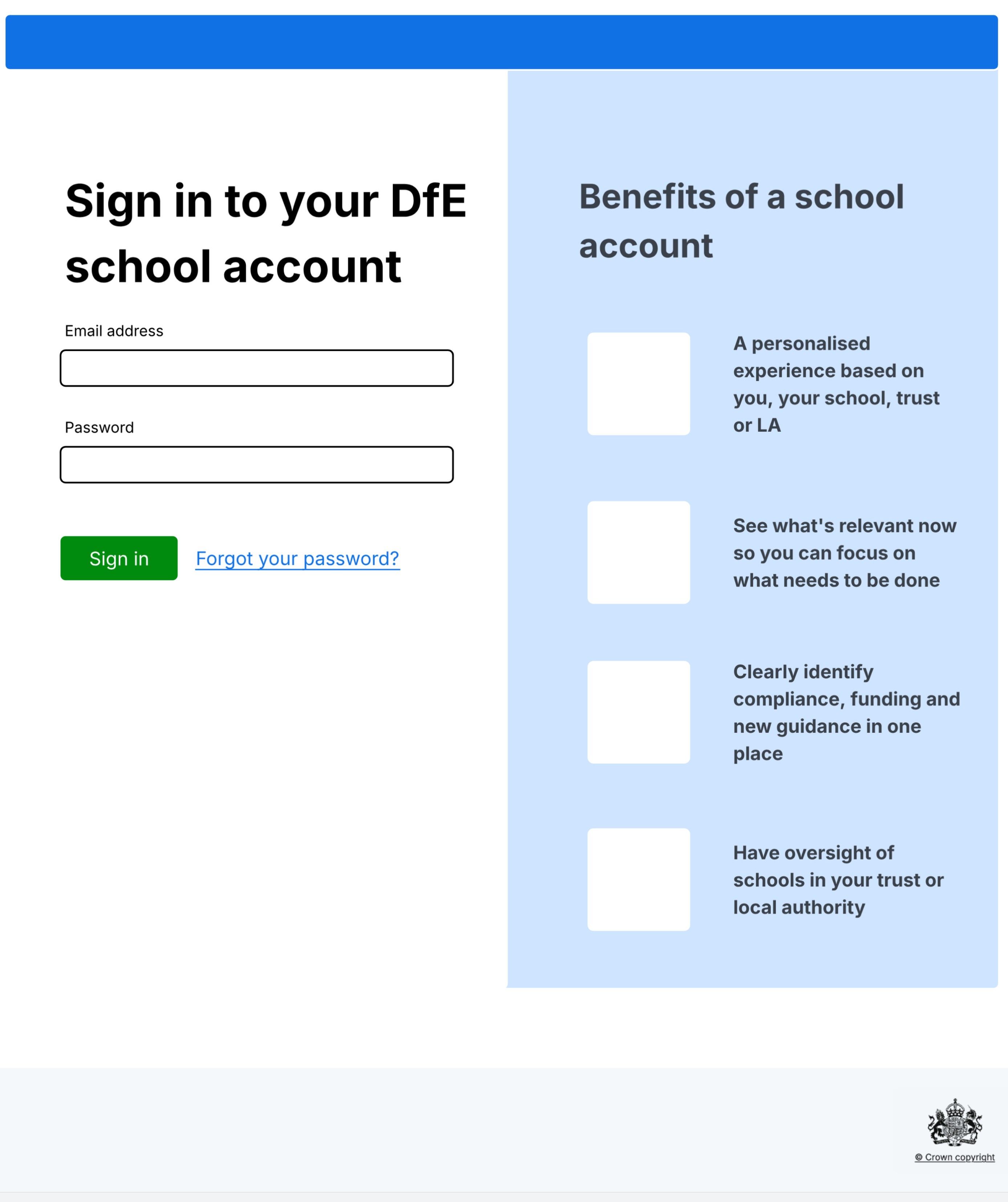
One of the things we wanted to test in terms of a seamless journey, was to call out the benefits of School Account at the point of the user arriving at DfE sign-in and entering their credentials.
Completing the summer census
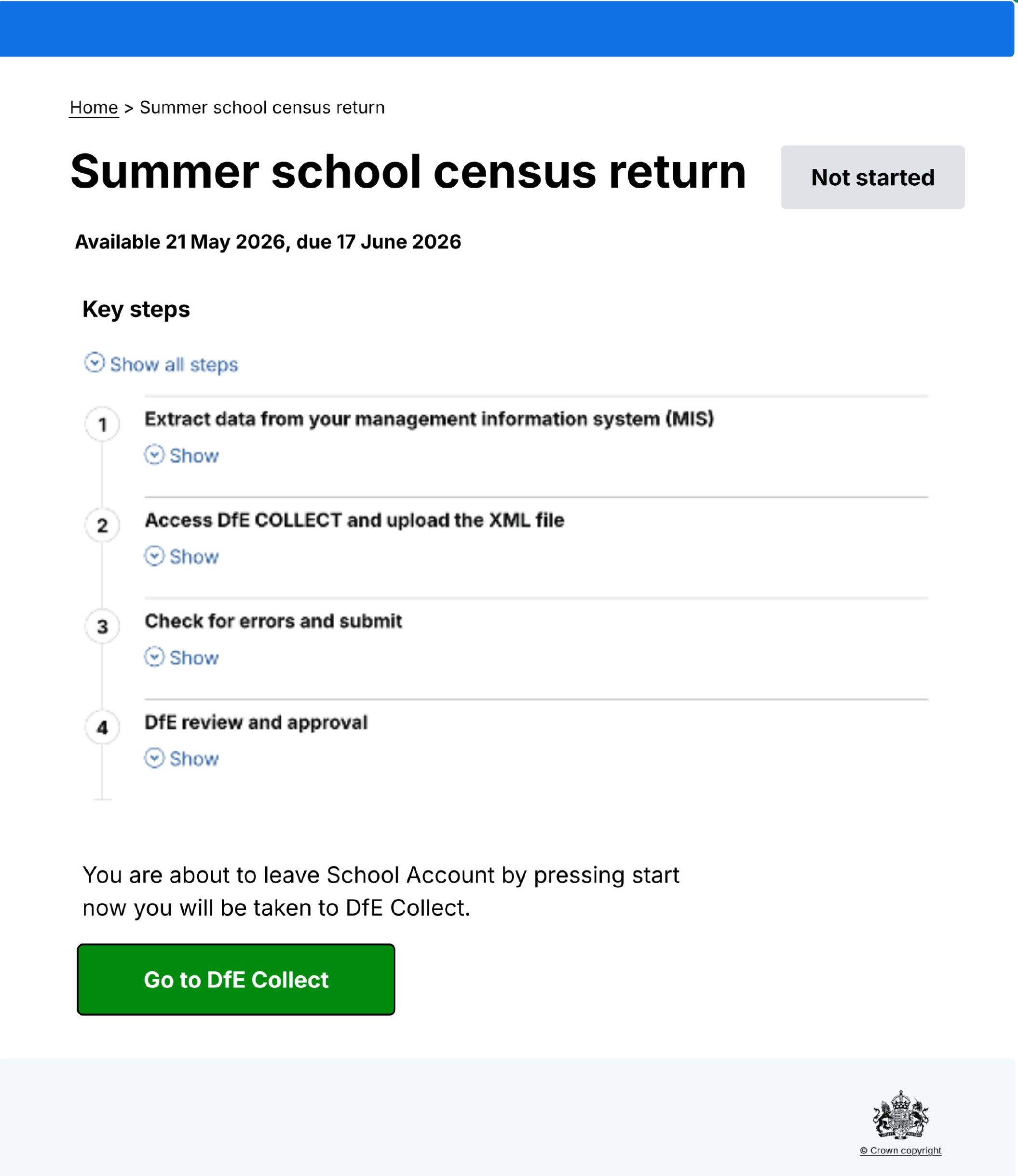
We then used the summer census journey, via DfE COLLECT to understand user expectations around what happens next and where they’d expect to go.
We acted on feedback with the structured guidance page to make it clearer that the headline information comes first (we changed this from ‘next steps’ to ‘key steps’ to underline this) and that once you hit the green button, you’ll be taken to another service.
The guidance page was well received, on the understanding that it would offer actionable steps. Users wanted to know 'what they need to know' before going to another service. Once briefed on the need-to-know information, they expected to go straight to the service, with few or no other steps, to complete their action without the need to log in again.
One research subject, a chief financial officer (CFO), talked about the budget forecast return process and how our proposed end-to-end flow feels much more joined-up and streamlined, with everything feeling easier to find and understand in a single place.
Users also called out that they’d want to see confirmation of the action they’d just taken. We again saw a need for clear statuses, particularly offering reassurance that an action had been completed, as well as notification of errors to be resolved.
Returning to the home page after the simulated journey, with status updates, was also well received. However, we’d move forward with this cautiously until we’re in a position to conduct a higher-fidelity test on how that returning journey might look, and the trigger points associated with it.
Overall, the findings suggest that joining up journeys reduces overall user burden more than it increases complexity.
Risky assumption 3: Users will trust the School Account as the primary place to find relevant information and complete tasks, rather than relying on external search or workarounds.
A recurrent theme, across the project to date, has been a desire for a ‘single, trusted source’ where users can find all relevant information in one place, while still integrating with their existing tools like calendars. We wanted to gauge whether a School Account will offer enough value to change user behaviour and see School Account as a single trusted source.
It was encouraging to hear that users mentioned replacing current processes and workarounds. One participant noted that a daily habit is to open a ‘DfE’ folder containing 5 different shortcuts simply to catch up, and that the proposed hub page design would replace the need for this, making it likely they’d use the new School Account ‘daily’.
Other users agreed that having compliance, guidance and funding all in one place improved upon the current situation of the same information spread across 3 different pages.
We did however also see that School Account offered the most value to school business managers (SBMs) with a broader range of responsibilities, who are likely to return frequently or keep it open continually. CFOs on the other hand, see some value, but are more likely to as come in as and when they need to, rather than keeping it open all the time.
Qualitative research
At the same time as the round 2 user research, we also sent out a survey to gather information on the likelihood of users adopting the proposed School Account concept, as well as testing some alternative versions of the hub page.
Top line figures were impressive and encouraging. We found that 69% of respondents were likely or extremely likely to use School Account, while 64% felt it would be ‘useful’ or ‘extremely useful’ and 91% felt it would improve their interactions with DfE.
We assessed different layouts with heatmaps to understood where users clicked across the different designs. There’s a detailed breakdown of the findings in the Concept testing alpha deck.
Next steps
The immediate next step for School Account is the alpha assessment, scheduled for early June. All being well, the project will then progress to private beta at which point we’ll shift our focus to developing the MVP so that we can start building.
We’ll also need to spend more time working out the detail of how School Account will be able to interact with other services in a scalable way.